
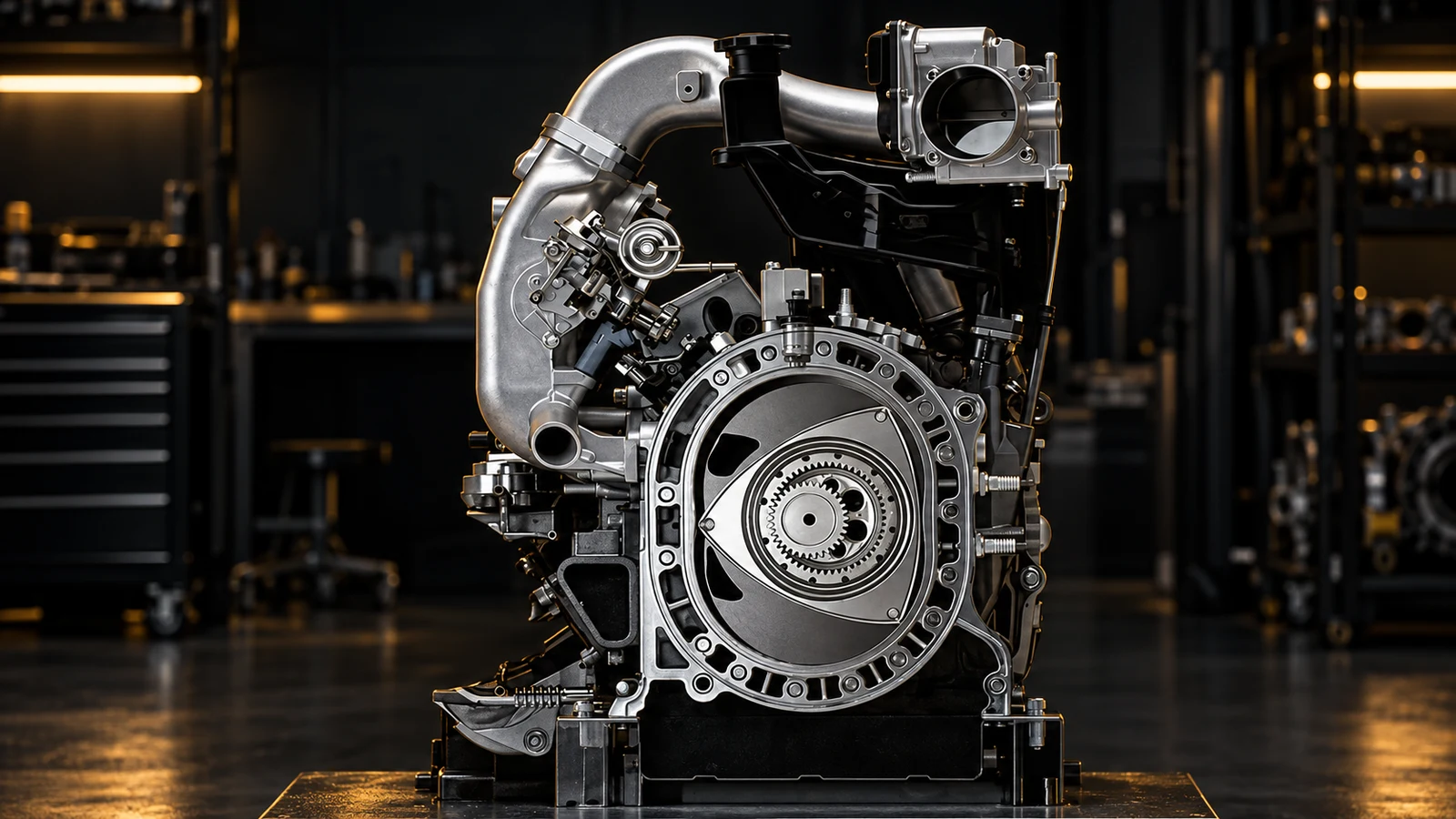
A rotary, or Wankel, engine burns fuel through the same four processes as a conventional four-stroke petrol engine: intake, compression, combustion and exhaust. The difference is the mechanism. A piston engine moves pistons up and down in cylinders, uses connecting rods to turn a crankshaft and normally needs camshafts and valves. A rotary engine uses a roughly triangular rotor moving inside a shaped housing to create changing combustion chambers and turn an eccentric shaft directly.
That makes the rotary compact, light and smooth. It also creates difficult sealing, lubrication, fuel-consumption and emissions problems. Those trade-offs explain both Mazda’s celebrated rotary sports cars and why the design never replaced the piston engine.
How does a rotary engine work?
The rotor has three curved faces and travels around an epitrochoid-shaped housing. Its tips remain close to the housing wall while an internal gear controls the rotor’s path around a stationary gear. An eccentric shaft passes through the rotor and carries the output to the transmission.
Each rotor face forms a separate chamber. As the rotor moves, each chamber changes volume and passes the intake and exhaust ports:
- Intake: chamber volume increases and draws in air and fuel.
- Compression: the chamber becomes smaller, compressing the mixture.
- Combustion and expansion: spark plugs ignite the mixture and pressure pushes on the rotor face, turning the eccentric shaft.
- Exhaust: the chamber reaches the exhaust port and expels the burned gases.
Several chambers are at different stages at the same time. In a two-rotor engine, two housings share one eccentric shaft, giving smoother and more frequent power delivery.
Why does a rotary engine use two spark plugs?
The combustion chamber is long and thin, so a flame has farther to travel than it does in many piston-engine chambers. Mazda road-car rotaries commonly use leading and trailing spark plugs to improve combustion across that space. Their condition, heat range and firing order therefore matter.
Does the rotor spin at engine speed?
No. The gearing makes the rotor turn at one third of the eccentric shaft speed. When an RX-8 tachometer shows 9,000 rpm, it is showing eccentric-shaft speed; the rotor itself is turning at about 3,000 rpm.
Rotary engine vs piston engine
| Feature | Rotary engine | Conventional piston engine |
|---|---|---|
| Main moving element | Triangular rotor | Pistons and connecting rods |
| Output shaft | Eccentric shaft | Crankshaft |
| Gas exchange | Ports in the housings | Usually camshaft-operated valves |
| Packaging | Very compact for its output | Usually larger for similar output |
| Vibration | Low reciprocating vibration | Reciprocating forces require balancing |
| Lubrication | Metered oil helps lubricate rotor seals | Oil is normally kept away from combustion |
| Main challenge | Sealing and combustion-chamber shape | More moving parts and valve-train complexity |
Why rotary engines are attractive
The Wankel removes pistons, connecting rods and a conventional valve train. Its few major moving assemblies rotate continuously rather than repeatedly stopping and changing direction.
The result is a small, light engine with little vibration and strong power for its physical size. Designers can mount it low and farther behind the front axle, which helped the Mazda RX-7 and RX-8 achieve favourable weight distribution. Rotaries also rev smoothly and deliver the distinctive response and sound that made Mazda’s RX models famous.
The best comparison is power against engine size and mass, rather than power per quoted litre. Rotary displacement is measured differently from piston-engine displacement, so a simple “1.3-litre versus 1.3-litre” comparison is misleading.
Why rotary engines have problems
Apex, side and corner seals
An apex seal at each rotor tip separates neighbouring chambers. Side and corner seals close the remaining gaps. These parts must maintain compression while sliding across surfaces with large temperature differences.
Wear or loss of sealing can cause difficult hot or cold starting, uneven running, reduced power and poor compression. Those symptoms are not proof of failed apex seals by themselves. Ignition, fuelling, starter speed and other faults can look similar, and compression must be tested with rotary-specific equipment and interpreted for cranking speed.
Oil consumption is partly intentional
Mazda rotary engines use an oil-metering system to send a controlled quantity of oil into the rotor housing. This lubricates the seals, but some of that oil enters the combustion process and is consumed. Owners therefore need to check the level regularly and use the oil grade and procedure specified for the exact engine.
Normal metered consumption should not be confused with uncontrolled oil burning, leakage or smoke caused by a fault. Premixing two-stroke oil into the fuel is an enthusiast practice, not a universal substitute for the manufacturer’s lubrication system.
Fuel economy, heat and emissions
The chamber is long and has a relatively large surface area for its volume. Flame travel takes longer and more heat can escape into the rotor and housings. Unburned mixture can also remain near the trailing edge as the exhaust port opens.
Those characteristics work against thermal efficiency and hydrocarbon control. Burning metered oil adds another emissions challenge. The RX-8 showed how a physically small engine could still return fuel economy more typical of a much larger performance car. UK figures vary by version and test cycle, so an owner should compare the exact model’s official figure rather than convert a US EPA result into UK mpg.
A short history of the rotary engine
Felix Wankel developed the concept with NSU, and the first running DKM prototype appeared in 1957. Mazda licensed the technology in 1961 and spent six years addressing housing chatter and seal durability before launching the two-rotor Cosmo Sport in 1967. Its 110 PS output is approximately 108 bhp, and its claimed 185 km/h top speed is about 115 mph.
After the 1973 oil crisis exposed the design’s thirst, most manufacturers withdrew. Mazda narrowed its focus to cars that benefited from compact size and low weight. The RX-7 arrived in 1978, followed by three generations and the renowned turbocharged 13B-REW. In 1991, the four-rotor Mazda 787B won Le Mans. It covered roughly 3,060 miles at an average 127.5 mph, and its R26B produced about 690 bhp at 9,000 rpm.
The naturally aspirated RENESIS in the RX-8 moved its exhaust ports to the side housings to reduce overlap and improve the use of expansion energy. RX-8 production ended in 2012 as emissions and fuel-economy requirements became harder to meet economically.
Is the rotary engine coming back?
It already has, but with a different job. In the Mazda MX-30 e-SKYACTIV R-EV, an 830 cc single-rotor engine works as a generator. The electric motor drives the wheels. This lets the rotary operate within a narrower speed and load range while its compact dimensions make it easier to package beside the electric drive system.
Mazda’s UK specification lists the car at 170 PS, about 168 bhp, but that is the electric drive system’s maximum output rather than direct rotary-engine power at the wheels. Mazda restarted a dedicated rotary-engine development group in 2024, with work focused on generator use, regulatory compliance and alternative fuels.
The rotary did not replace the piston engine because its sealing and combustion disadvantages matter greatly in everyday road use. It remains valuable where compactness, low vibration and power density can outweigh fuel and emissions compromises.
What should you check when buying a used rotary car?
- Ask for a cold start and a fully warm restart.
- Check oil level and service records, including the correct oil and change intervals.
- Confirm the ignition coils, leads and spark plugs are the correct parts and have documented history.
- Look for coolant loss, oil leaks, warning lights and evidence of repeated flooding.
- Arrange a rotary-specific compression test rather than relying on a conventional gauge or one unexplained number.
- On modified or remapped cars, check the fuelling, cooling and ignition setup before assuming the engine is healthy.
If you are considering diagnostics or tuning, contact BSG Automotive with the registration, engine details and current symptoms so service suitability can be confirmed before booking.
Frequently asked questions
Is a rotary engine a two-stroke engine?
No. It completes intake, compression, combustion and exhaust, but it does so through chambers created by a moving rotor rather than piston strokes in cylinders.
Do all rotary engines have apex-seal problems?
No. Apex seals are critical wear components, but starting or compression problems can also come from ignition, fuelling, lubrication or starter-speed faults. Diagnosis should be based on the exact engine and a rotary-specific compression test.
Why does a rotary engine burn oil?
Its oil-metering system supplies oil to lubricate the rotor seals and housing surface. A controlled amount is therefore consumed during normal operation, although excessive smoke or consumption still requires investigation.
Does the MX-30 R-EV rotary engine drive the wheels?
No. The electric motor drives the wheels. The single-rotor petrol engine generates electricity for the drive system and battery.
You might also like
- What is a turbocharger and how does it work?
- Car exhaust systems explained
- Timing chain vs timing belt