
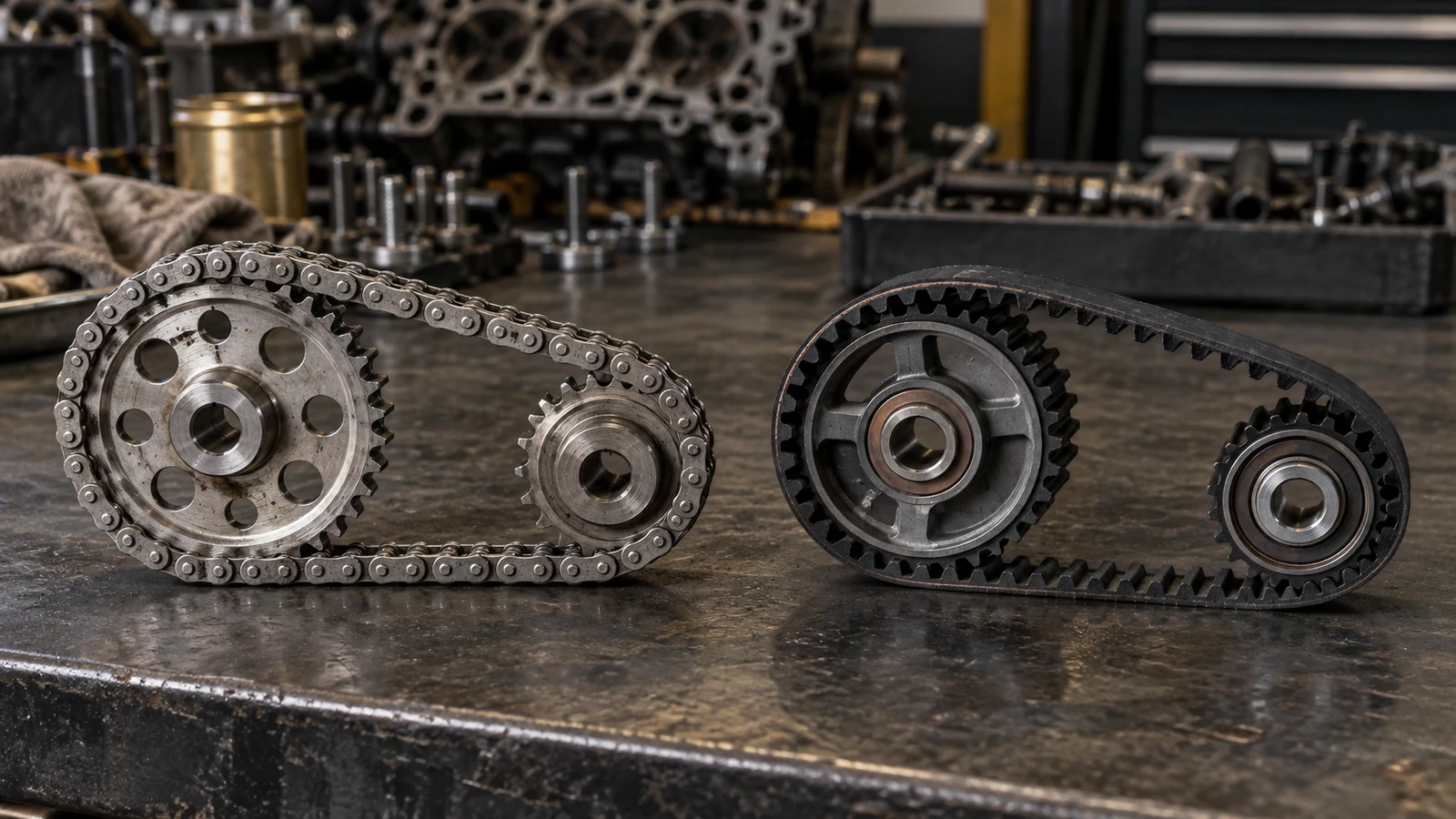
Illustrative image: generic timing components, not a documented BSG customer engine.
A timing belt and a timing chain do the same essential job: they keep the crankshaft and camshaft turning in the correct relationship, so the valves open and close at the right point in each engine cycle. The difference is how they do it, how they wear and how they are maintained.
Neither design is automatically more reliable. A belt can give long, predictable service when it is replaced on schedule. A chain can last for a very high mileage, but it still depends on clean oil, an effective tensioner and sound guide rails. The exact engine and its service history matter more than the word belt or chain.
How engine timing works
The crankshaft turns as the pistons move. The camshaft, or camshafts, operate the valves. On a four-stroke engine, the camshaft normally turns once for every two crankshaft revolutions. A toothed belt or chain transfers that movement without allowing the two shafts to lose their timed relationship.
Many modern engines are interference engines. If the timing drive breaks or jumps far enough, an open valve may meet a rising piston, potentially damaging valves and pistons. An overdue belt, persistent chain rattle or camshaft-to-crankshaft correlation fault therefore deserves prompt attention.
Depending on the engine, the drive may also operate a fuel pump, oil pump, balance shaft or water pump. The correct repair scope comes from the manufacturer’s procedure, not a universal parts list.
How a timing belt works
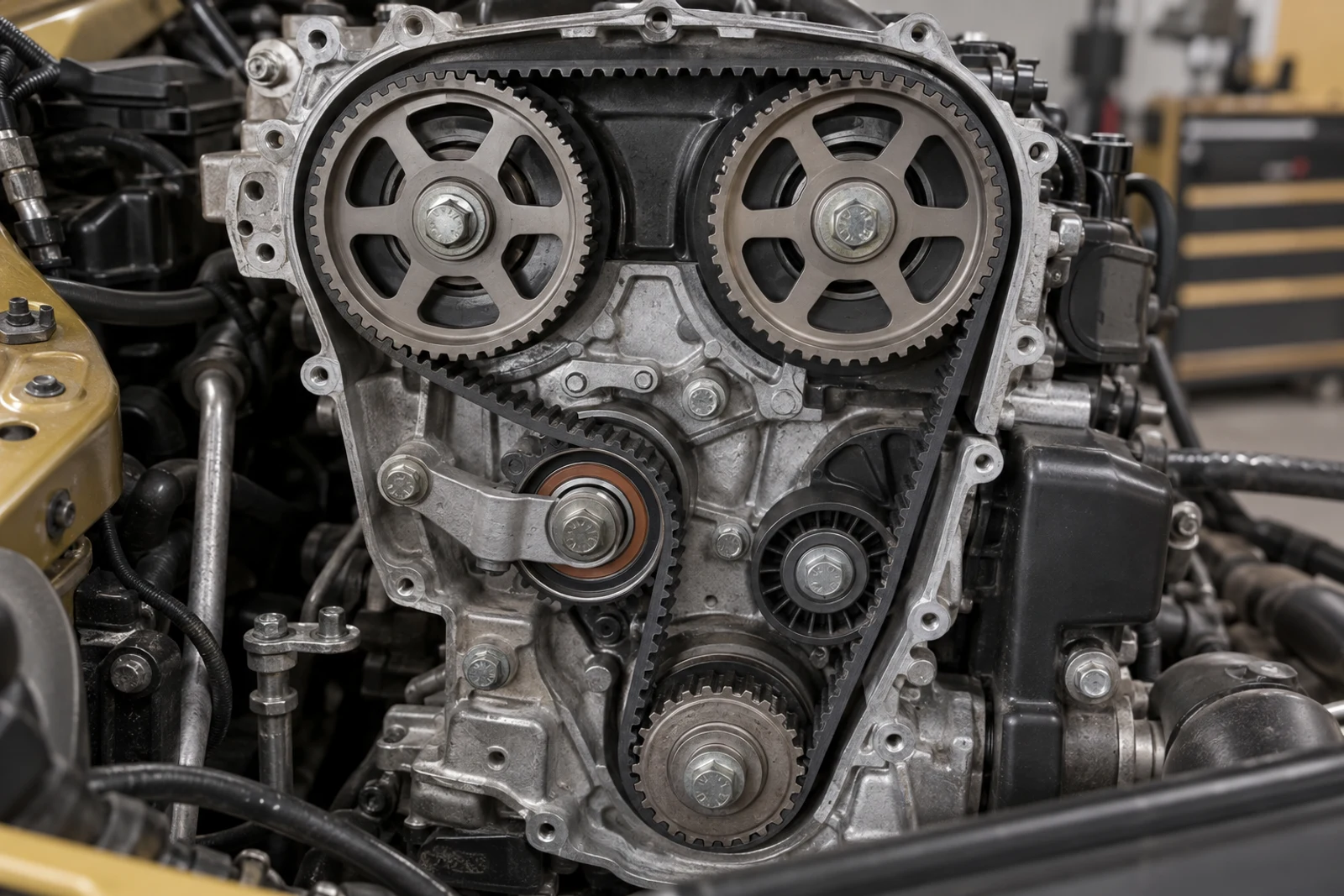
A conventional timing belt is a reinforced toothed belt running over toothed pulleys. A tensioner keeps it correctly loaded, while idlers guide its route. Most conventional belts run behind covers outside the engine’s pressurised oil circuit. Some newer engines use a belt-in-oil, often called a wet belt, which runs inside the engine.
Timing belt advantages
- Quiet and light in operation.
- Usually has a defined replacement schedule, making the main timing service easier to plan.
- A conventional belt system can be simpler and less expensive to service than a chain buried at the rear of an engine, although access varies greatly.
Timing belt disadvantages
- Replacement is required by time, mileage or both, according to the vehicle schedule.
- Oil, coolant, incorrect tension, pulley problems and installation errors can shorten its life.
- A belt may fail or shed teeth without a useful audible warning.
- Wet belts are especially sensitive to the specified oil and maintenance regime; loosened material can affect more than the belt itself.
During replacement, the workshop should follow the engine-specific procedure and assess the tensioner, idlers, seals and any belt-driven water pump. Water-pump replacement is common on some engines, but not universal.
How a timing chain works
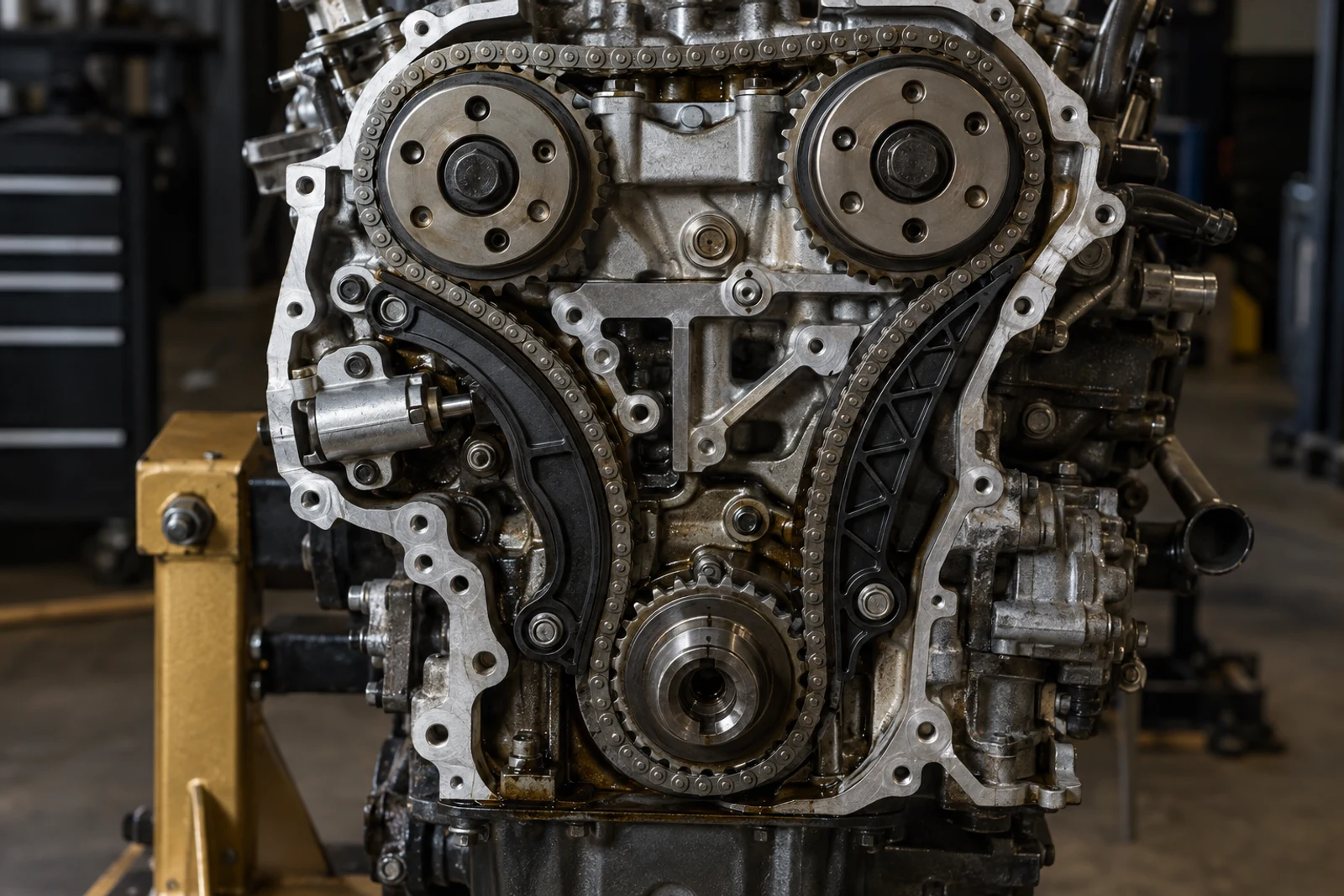
A timing chain uses metal links running over sprockets inside the engine. Guide rails control its path, while hydraulic or mechanical tensioners control slack.
“Chain stretch” usually describes accumulated wear at the chain pins and joints rather than the steel links physically stretching. As the effective pitch increases, camshaft timing can move away from its intended position. A worn tensioner, damaged guide or sprocket wear can also let the chain run loose or jump.
Timing chain advantages
- Often has no routine replacement interval in the normal service schedule.
- Can provide long service when the complete system is well designed and the engine receives the correct oil at the required intervals.
Timing chain disadvantages
- It is not maintenance-free: oil condition, tensioners, guides and sprockets all matter.
- Diagnosis and replacement can be labour-intensive, particularly when the chain sits at the flywheel end of the engine.
- Warning signs are not guaranteed. Some chains rattle or set correlation faults; others can deteriorate with little obvious warning.
- Repair normally involves guides and tensioners as well as the chain.
Timing belt vs timing chain at a glance
| Question | Timing belt | Timing chain |
|---|---|---|
| What drives it? | Toothed reinforced belt | Metal chain and sprockets |
| Lubrication | Usually dry; some engines use a wet belt | Runs in engine oil |
| Routine replacement | Usually specified by time/distance | Often no scheduled interval |
| Typical warning | May have little audible warning | May rattle or log timing faults, but not always |
| Main dependencies | Age, contamination, tension and pulley condition | Oil condition, tensioner, guides, joints and sprockets |
| Service cost | Often more predictable | Can be higher where access is difficult |
What should you check on a used car?
For a belt-driven engine, confirm the exact interval and ask for an invoice showing when the work was completed and what parts were fitted. A sticker is weaker evidence than an itemised invoice.
For a chain-driven engine, look for consistent servicing with the correct oil. Listen from cold, scan for faults and investigate persistent rattling, poor running or timing-correlation codes. Clearing a code or fitting a tensioner will not necessarily correct wear elsewhere.
In both cases, leaks, oil-filter debris, uncertain history or a warning light justify further checks before purchase or tuning.
Which is better?
A timing chain is attractive because it may not have a scheduled replacement interval. A timing belt is attractive because its main service point is usually defined. Neither advantage overrides a weak design, incorrect oil, missed servicing or poor repair work.
Choose the car on the evidence: the exact engine code, manufacturer schedule, known production changes and documented maintenance. If a timing fault is suspected, diagnose it before replacing isolated parts or adding performance load.
Frequently asked questions
Does a timing chain last for the life of the engine?
It may last for a very high mileage, but “no scheduled replacement” does not mean “cannot wear”. The chain, tensioner, guides and sprockets work as a system, and their life depends on the engine design, oil and operating history.
How often should a timing belt be changed?
Use the schedule for the exact vehicle, engine, market and model year. The limit may involve time, distance or both. Do not substitute a generic interval from another model that uses a related engine.
Can a diagnostic scan confirm a worn timing chain?
A scan can reveal camshaft-to-crankshaft correlation faults and related data, but it is only part of the diagnosis. Noise, oil condition, debris, mechanical checks and engine-specific procedures may also be needed.
Should a timing belt or chain be checked before remapping?
Yes when the engine has a known timing concern, suspicious noise, relevant fault codes or incomplete maintenance history. A remap does not create an existing mechanical fault, but increasing load on an unhealthy engine is poor practice.
You might also like
- BMW N47 2.0 diesel remap guide — checks to consider before increasing engine load.
- BMW N57 3.0 diesel remap guide — engine-specific tuning context for the six-cylinder diesel.
- Buying a used car in the UK — a broader inspection and history checklist.
Sources and further reading
Always use the current manufacturer schedule and repair information for the vehicle identified by its VIN.